
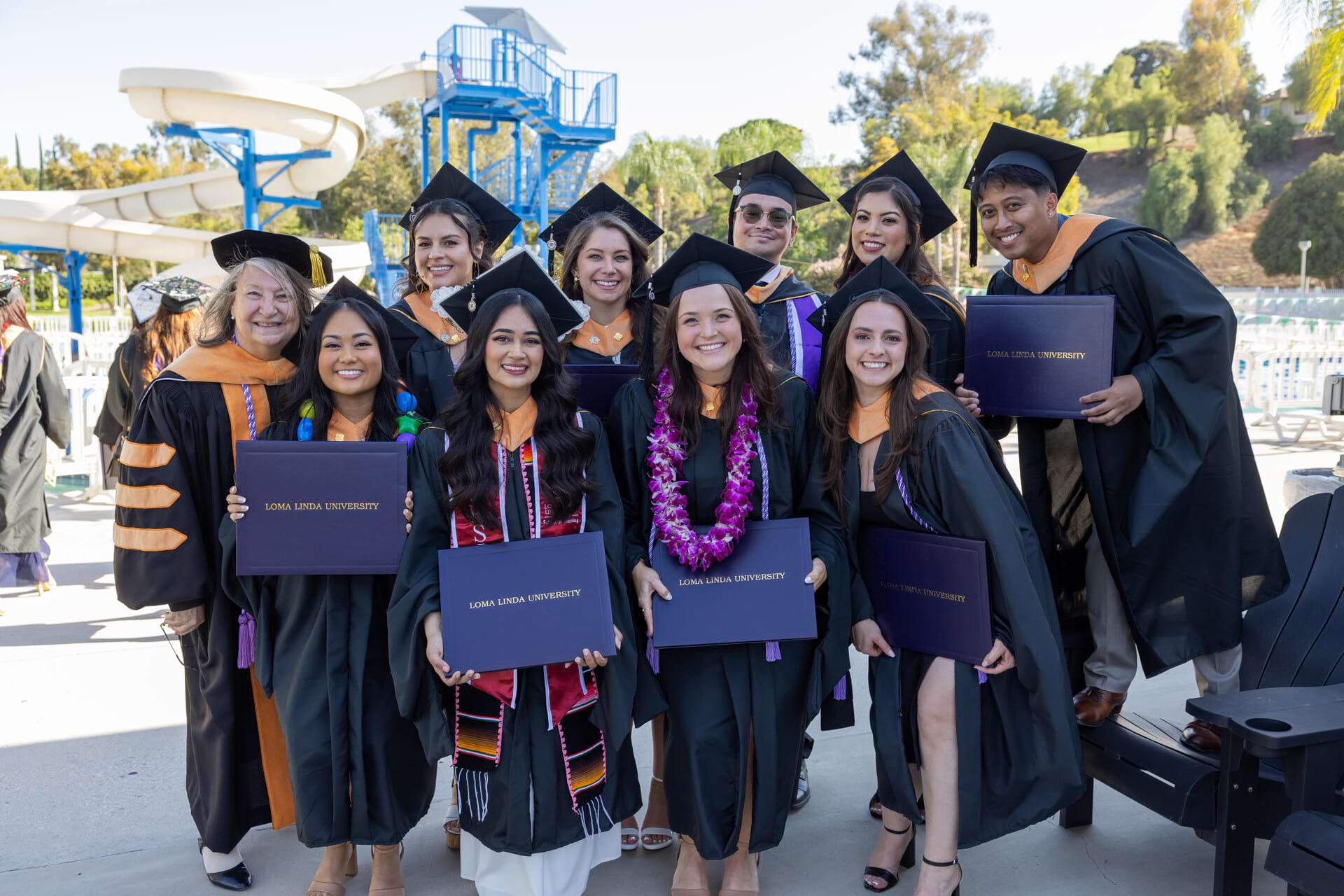
Loma Linda University School of Nursing has reached a historic milestone with the graduation of its first Entry-Level Master's (ELM) cohort, marking a new chapter in the school's commitment to preparing innovative nurse leaders through nontraditional pathways to the profession.
The inaugural class of 10 graduates represents the successful launch of a program designed for students who already hold bachelor's degrees in other disciplines and are seeking to transition into nursing while earning a master's degree. Their achievement not only reflects personal perseverance but also demonstrates the potential of a program created to address California's growing need for highly educated nursing professionals. For graduate Olivia Hogue, who entered the program with a bachelor's degree in public health, the ELM pathway offered the opportunity to build on an existing foundation without starting over. "When Loma Linda introduced the ELM program, it felt like the perfect fit as it allowed me to directly integrate my public health background with nursing, especially given the program's strong emphasis on population health," she said.
Because the program combined undergraduate prelicensure coursework with graduate nursing education, the first cohort navigated a unique academic structure unlike any other at the School of Nursing. During the first 18 months, students completed foundational nursing courses alongside Bachelor of Science in Nursing students before transitioning into graduate coursework during the program's final months. Throughout the process, administration worked closely together to provide consistent guidance and support while fostering collaboration across the School of Nursing.
That collaborative approach extended beyond the classroom. Faculty from both undergraduate and graduate programs partnered to strengthen student preparation for licensure through a comprehensive NCLEX readiness strategy. "We are grateful for the opportunity that leadership has provided to use the NCLEX prep program at LLUSN," said Dr. Joanna Shedd and Dr. Erin Heim. "We used the recommendations by the product's company and worked together as undergraduate and graduate team to give the students the best opportunity to pass on the first try." Their coordinated efforts helped the inaugural cohort achieve a remarkable 100 percent first-time NCLEX pass rate, establishing an exceptional standard for future graduates.
Dean Shawn Collins said seeing the program progress from an ambitious vision to its first graduating class has been especially rewarding. He noted, "The ELM is a vision of how we could prepare nurses differently. Watching that vision become graduates, ready to step into their careers, is a reminder of why we do this work."
The inaugural cohort also faced challenges beyond the classroom. Many had exhausted undergraduate financial aid eligibility after earning previous degrees, limiting access to traditional funding sources. Others left established careers or balanced family responsibilities while commuting long distances for clinical experiences at Loma Linda University Medical Center Murrieta. Despite those obstacles, the students remained focused on their goals and developed a close-knit community built on resilience and mutual support.
Reflecting on the experience, Hogue said, "Starting the program without knowing anyone was intimidating at first, but my cohort quickly grew incredibly close. They feel like family now. We constantly cheered each other on and supported one another through the finish line."
Their resilience and willingness to provide candid feedback also helped shape the program as it developed. Collins said the inaugural students became partners in building the ELM program, offering input on coursework, clinical placements, and pacing that allowed faculty to make real-time improvements. Future cohorts will benefit from the engagement and insight this first class provided.
Their experiences have already shaped the future of the program. Beginning in 2026, all ELM coursework transitioned to the graduate level, expanding opportunities for federal financial aid. The program also plans to relocate both classroom instruction and clinical education to the Murrieta campus, reducing travel time and costs for future cohorts.
The graduation marks more than the completion of a degree program. It demonstrates that innovative approaches to prelicensure nursing education can expand opportunities for students while helping address the growing demand for highly educated nurses. It also reflects the School of Nursing's ongoing commitment to adapting its educational pathways to meet the evolving needs of healthcare.
Aligned with the School of Nursing's mission to prepare clinicians, educators, and researchers committed to whole person care, these graduates enter the profession uniquely positioned to lead. As master's-prepared registered nurses, they are equipped to pursue leadership, education, research, and population health roles earlier in their careers while helping address the growing need for nurse educators.
For Collins, this inaugural graduation represents "...proof that the program works and that our approach to training the next generation of nurses is sound. It also reflects our mission: preparing compassionate, highly skilled clinicians who are ready to serve from day one." He continues, "This is just the beginning. This first cohort sets the standard and the culture for everyone who follows. I see this program becoming a model — not just at LLU, but for how nursing education adapts to meet the evolving needs of patients and the healthcare system."