
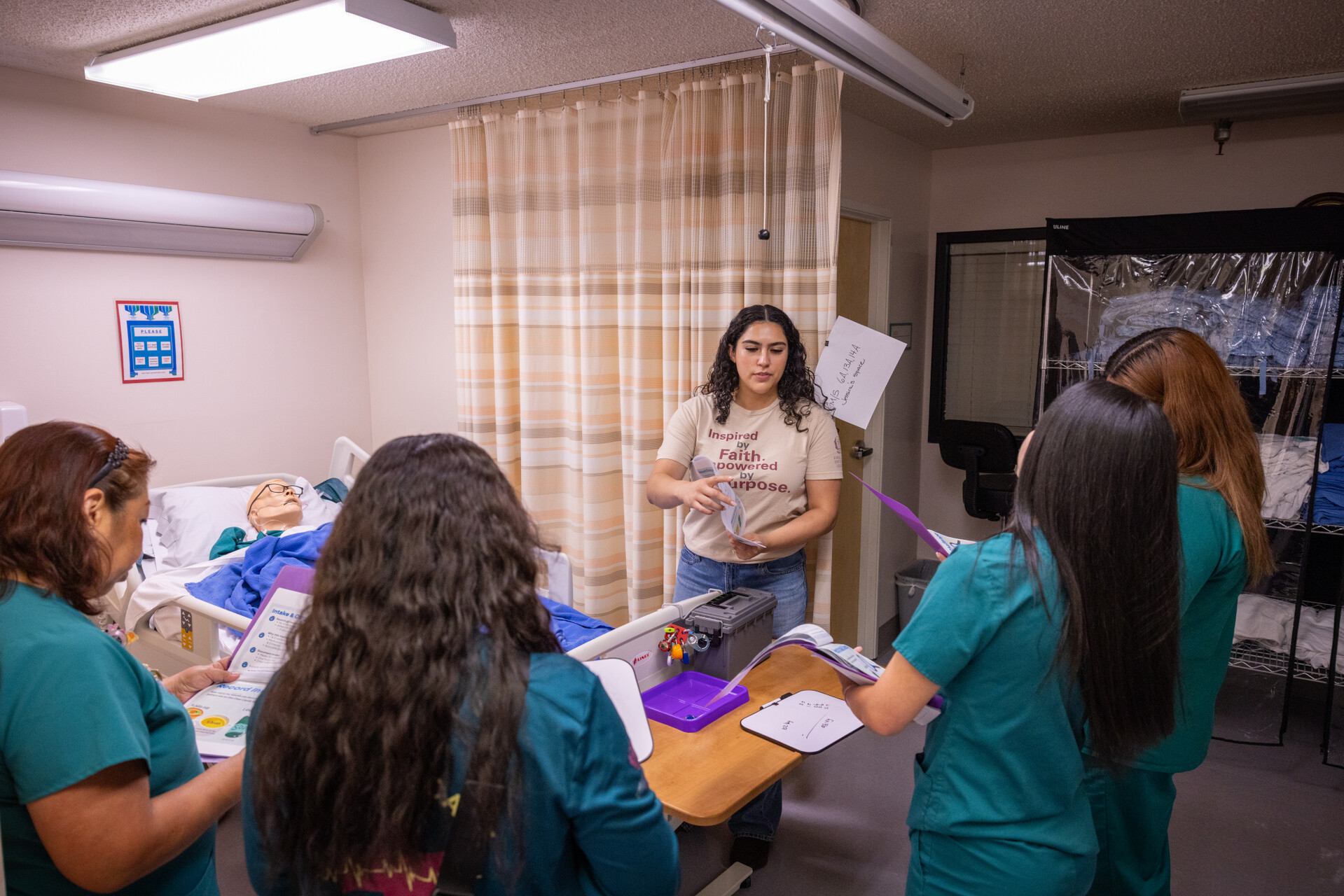
This summer, the Loma Linda University School of Nursing once again transformed its classrooms, simulation suites, skills labs, and computer labs into a hub for clinical excellence as more than 2,000 nurses from Loma Linda University Medical Center participated in annual service line training sessions.
What began as a partnership with a handful of inpatient units has expanded into a collaborative educational effort supporting multiple service lines across the health system, including Pediatric Critical Care, the Neonatal Intensive Care Unit (NICU), and two Acute Care Medical-Surgical service lines representing units across both adult campuses.
The partnership grew from a shared commitment to supporting both nursing education and the practicing nurses who help prepare the next generation of caregivers.
"As a School of Nursing, we have a responsibility not only to educate future nurses but also to support the nurses who are already providing exceptional patient care every day," said Brandie Richards, associate dean of undergraduate nursing programs and student affairs. "Our hospital teams invest countless hours mentoring our students during clinicals and practicums. Opening our doors to support their professional development is one meaningful way we can give back."
The annual sessions provide hospital nursing teams with dedicated time away from patient care to strengthen clinical skills, practice emergency response scenarios, and refine documentation processes in a realistic, hands-on learning environment.
For the Acute Care Surgical & Specialty Services teams, the School of Nursing offered an ideal setting for this year's training.
"We chose to host our training events at the Loma Linda University School of Nursing this year because it provided great flexibility in scheduling, allowing us to offer dedicated training sessions for both our Patient Care Assistants and Registered Nurses and better support their unique professional development needs," said Jessica Tracy, BSN, RN, clinical educator for LLUMC Acute Care Surgical & Specialty Services, and Michelle Schwab, MSN, RN, APRN-CNS, AGCNS-BC, TCRN, educator clinical nurse specialist for LLUMC Acute Care Surgical & Specialty Services, in a joint statement.
The educators said the collaboration was especially meaningful because many members of their nursing teams are School of Nursing alumni or current students, further strengthening the connection between education and clinical practice. They also noted that the school's simulation facilities and equipment allowed them to create realistic, hands-on training scenarios that closely mirror the environments and challenges nurses encounter in their patient care units.
Throughout the summer, each service line designs its own curriculum based on the unique needs of its nursing teams. While every department has specialized training objectives, common learning experiences include practicing documentation within the LEAP electronic health record training environment, participating in mock code and rapid response simulations using unit-specific equipment, and rehearsing emergency response procedures in hallways and stairwells to mirror real clinical environments.
Behind the scenes, the School of Nursing's simulation team works months in advance to prepare for the program. MaryJo Schaarschmidt, director of undergraduate simulation, and Simulation Operations Specialist Gabe Treuhaft collaborate closely with nurse educators from each service line to coordinate equipment, simulation technology, and educational resources. Lisa Butler, program coordinator in the Dean's Office, manages the complex scheduling of classrooms and simulation spaces, ensuring every department has the facilities needed throughout the summer.
The partnership reflects the unique strengths of an academic medical center, where education and clinical practice continually reinforce one another.
"There is a true enrichment when a nursing school is affiliated with a hospital," Schaarschmidt said. "Loma Linda is so fortunate to have this partnership. Building the connection between the nursing staff and their units to the school allows us to share resources in academics, clinical practice, research, and the development of our newest nursing graduates."
Ultimately, the greatest beneficiary is the patient. By giving experienced nurses dedicated opportunities to practice high-risk, low-frequency events such as code responses, improve documentation accuracy, and strengthen teamwork in a low-pressure environment, the School of Nursing helps reinforce a culture centered on patient safety and continuous learning.
"The educators are fiercely protective of their staff and want to bring the very best to them," Schaarschmidt said. "These sessions give nursing teams time away from the unit to be vulnerable with one another, learn new skills, and practice together in a relaxed and supportive environment."
Richards said the collaboration demonstrates what is possible when academic and clinical partners work toward a common purpose.
"Our goal is to build stronger bridges between the classroom and the bedside," Richards said. "When academic and clinical partners work together, everyone benefits—our current nurses, our students, and ultimately the patients we serve."
She said the initiative reflects more than a shared training opportunity—it reinforces a shared identity across the university and health system.
"This partnership reinforces that we are one nursing community working toward the same mission of excellence in patient care."